
In 2014, FIIs have infused a net amount of Rs 1,59,157 crore ( 1.59 trillion) in the debt markets.

Earners in between Rs 50 lakh and Rs one crore will have to pay 10% surcharge
Earners in between Rs 50 lakh and Rs one crore will have to pay 10% surcharge

The local currency dropped to 61.75 before concluding at 61.70, a loss of seven paise from its previous close.

The S&P BSE Small-cap index has recovered 26 per cent as compared to a 23 per cent rise in the S&P BSE Sensex.

The reduction in holdings comes at a time when technology firms are facing cross currency headwinds due to volatility in the global financial markets

The US Federal Reserve on Wednesday (local time) raised interest rates by 75 basis points (bps) or three-quarters of a percentage point in the boldest move since 1994.

With most Adani Group shares locked in lower-circuit in early morning trade based on news that accounts of three foreign portfolio investors, heavily invested into group companies, were frozen by the National Security Depository Limited, market experts advise caution that investors should not jump in now to buy at lower levels.

'The correction could take two to three months and traders need to be careful.' 'For investors, this could be a good time to nibble in.'

The broader NSE Nifty, in a volatile session, recaptured the key 11,300-mark. It ended at 11,369.90, up 82.40 points or 0.73 per cent.

Besides higher tax outgo, P-note issuers are worried about operational difficulties

The 50-share NSE Nifty plunged 98.65 points, or 0.87 per cent, to end at 11,278.90.

In February, FPIs sold $421 mn in debt; in March they have sold $133 mn so far

'At this moment, investors should look for relative value within sectors and clear visibility (third-wave-or-not) on earnings delivery.'

Park only savings that need not be touched for many years, says Devangshu Datta.
Hero MotoCorp, Bajaj Auto, M&M and Tata Motors were the major winners.

The 50-share Nifty scaled a high of 10,207.90 intra-day but succumbed to profit-booking to finish at 10,184.15, up 53.50 points

In the centre of an ownership battle with Adani Group, New Delhi Television (NDTV) can prevent a takeover by the group if it can buy more shares from public shareholders, corporate lawyers told Business Standard. On Tuesday, the media arm of Adani Group said it had exercised rights to acquire an indirect stake of 29.18 per cent in NDTV through conversion of loans into equity in a promoter group entity of NDTV. This will trigger a mandatory open offer for an additional 26 per cent stake in NDTV, even as the broadcaster said its founder promoters had neither consented to the exercise of rights nor was any conversation or input given on the matter.
The uncertainty over the gravity of the pandemic's impact on the global economy and financial markets worldwide triggered a flight to safety among foreign investors as they rushed to exit from relatively riskier investment destinations, such as emerging markets like India, a report said.

The rupee on Wednesday strengthened by another 3 paise to 62.82 against the US dollar.

Investor sentiments remained upbeat tracking global developments as the US, China geared up for trade talks due this week.

It is to be seen if SBI under Setty, who will have a three-year term, can ride the economic cycle to take SBI to new heights, navigating some of these challenges.

Analysts said even though the Indian economy is expected to slow down to 7.2 per cent in fiscal 2020, it is still the best bet for investment for foreign investors.

Mutual funds (MFs) are set to be net sellers of Indian equities for the first time in the past seven financial years, having sold stocks worth about Rs 1.27 trillion so far in 2020-21 (FY21), making it the highest net sales on record in a financial year. MFs had been net buyers in the previous six financial years, including purchases of over Rs 1.41 trillion in FY18, Rs 88,152 crore in FY19, and Rs 91,814 crore in FY20. The last time they offloaded Indian equities was in FY14, when they net sold stocks worth Rs 21,159 crore. In contrast, foreign portfolio investors (FPIs) have ramped up buying in FY21, purchasing more than Rs 2.6 trillion worth of shares.

The biggest losers of the session include Reliance, Infosys, TCS, ICICI Bank, HDFC twins, ITC, Maruti, L&T, HUL, Axis Bank, Wipro and IndusInd Bank, cracking up to 4 per cent.

The Securities and Exchange Board of India (Sebi) has introduced an optional T+1 settlement cycle for the markets. T+1 means that settlements will have to be cleared within one day of the actual transactions taking place. The regulator has put the onus on the stock exchanges to decide whether they want to opt for the shorter settlement cycle for any of the listed scrips. This can be done after giving a one-month prior notice to all stakeholders.

The 50-share NSE Nifty after moving between 10,374.30 and 10,307.30 settled flat at 10,348.75, up 6.45 points, or 0.06 per cent.

Among the Sensex firms, Bajaj Finance emerged as the biggest gainer by climbing 2.95 per cent. Tata Motors, Bajaj Finserv, IndusInd Bank, Sun Pharma, Mahindra & Mahindra, State Bank of India, Larsen & Toubro, HDFC, HDFC Bank, Maruti, Reliance Industries and Bharti Airtel were the other major winners. HCL Technologies, Axis Bank, ICICI Bank, Tech Mahindra and Titan were among the laggards.

After a a steep fall last week, the rupee has closed slightly stronger against the dollar.
Late selling in realty, PSU and infrastructure stocks mainly dragged the market from early highs.

Investments in Indian capital market through participatory notes (P-notes) dropped to Rs 94,826 crore till November-end after hitting 43-month high in the preceding month. P-notes are issued by registered foreign portfolio investors (FPIs) to overseas investors who wish to be a part of the Indian stock market without registering themselves directly. They, however, need to go through a due diligence process.

The rupee had plummeted to over three-month low of 63.32.

Appreciating rupee against the dollar and fresh buying by domestic institutional investors added to the momentum

Global funds have pumped in over Rs 38,000 crore (about $5.5 billion) into domestic equities since February 20, helping the Sensex rebound 2,671 points, or 7.6 per cent, from its 2019 low.
The move will increase working capital requirement for brokers, raise the work load on the system and will leave little room for contingencies.

The biggest gainers on both the bourses were Reliance Industries, Infosys, NTPC, ONGC, HUL, PowerGrid, Asian Paints, ITC and HCL Tech, rising up to 2 per cent.

Both the indices closed at five-month highs, led by financial services, IT and metal stocks, amid persistent foreign fund inflows.
The local currency had surged 18 paise to 63.64 in Thursday's trade.

Domestic markets are also aided by a rally in the global markets with US market surging to record high and a firming trend at other Asian bourses.
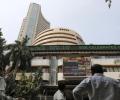
The broader Nifty declined by 73.90 points, or 0.71 per cent, to end at 10,378.40.
